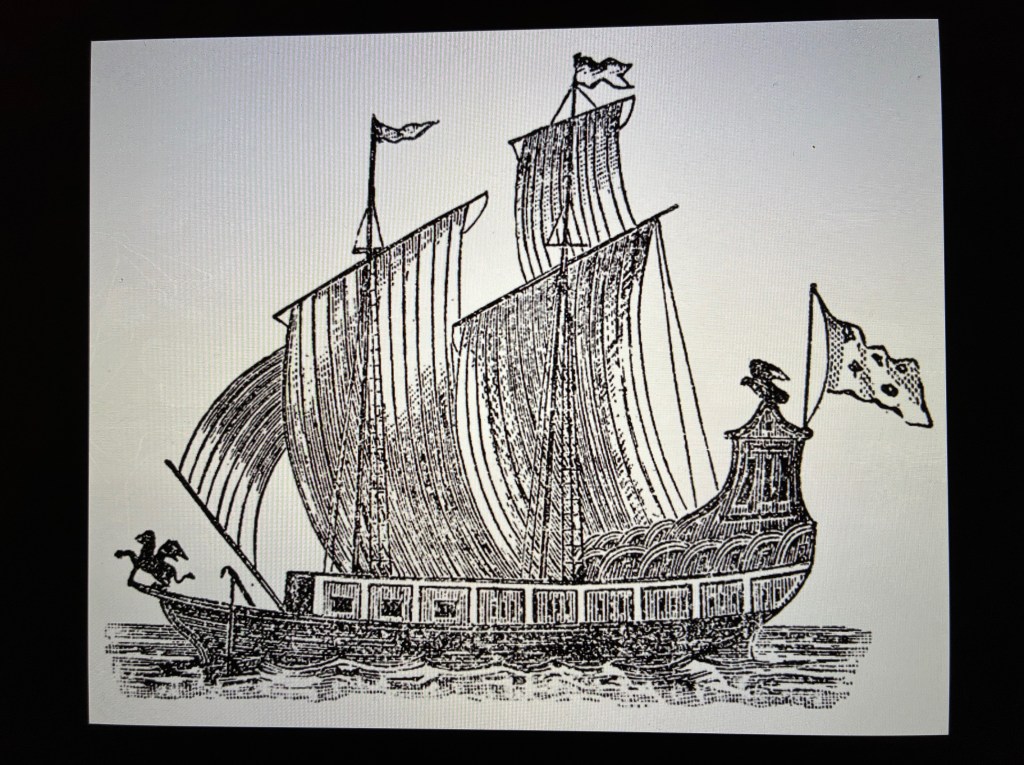
Nearly 350 years ago on this very day (January 26), a small but notable event took place along the Niagara River about six miles from the brink of the falls. It was on that snowy January day when French explorer and trader, Robert Cavalier de La Salle drove the first pin of the keel of the vessel to be named Le Griffon.
LaSalle chose the site to build his ship near where Cayuga Creek enters the Little Niagara, a tributary that separates the small Cayuga Island from the coastline of present-day Niagara Falls.
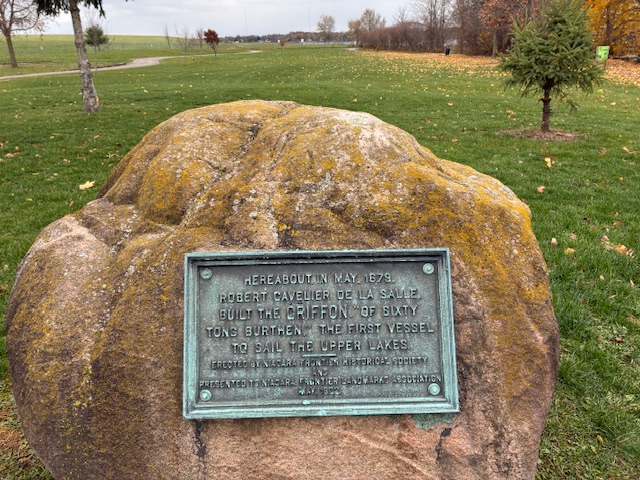
In November of last year (2025), I went to Griffon Park, off Buffalo Avenue in Niagara Falls. There’s a boulder with a plaque recognizing the building of Le Griffon.
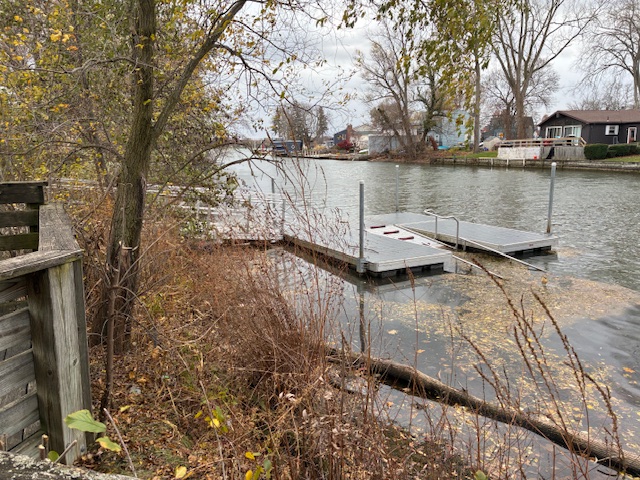
The closest thing to a nautical theme at the park is the kayak launch, across from a neighborhood on the other side of Little Niagara whose owners are probably unaware that a bunch of French explorers and tradesmen wandered the woods where their houses now stand.
On that chilly day in November, I stood for a moment, trying to imagine what the park may have looked like back then, but it was difficult to get an idea of what it would have been like 346 years ago as the traffic sounds of the LaSalle Expressway zooming by and the view of the chain link fence enclosing the chemical landfill adjacent to the park distracted my concentration.
The shipwrights worked through 1679 to complete Le Griffon, which was the first sailing ship to sail the upper Great Lakes, and it was ready to sail by the summer of that year. (The indigenous people who inhabited the Great Lakes, of course, were the first humans to travel the waters by boat. The Senecas used long canoes as they traded with other native tribes who lived along the coastlines.)
I soon left the park and made my way along the LaSalle expressway, and stopped at Gratwick Park a few miles down the road. The strong northerly winds were creating waves that traveled in the opposite direction of the prevailing current, creating white caps and steep waves about a foot or two high.
The captain of the Griffon had to wait for such a wind in order to propel the ship against the current toward Lake Erie. Later that day, when they made it closer the rapids where Unity Island is located and under the present day Peace Bridge, twelve men were dispatched to shore to haul the ship through the rapids to a calmer area, which some believe would be just off Porter Avenue where the Colonel Ward Pumping Station is.
The design and size of Le Griffon is unknown, but estimates put the length of the ship at about 55 feet long. The current of the Niagara River under the Peace Bridge is about 12 miles an hour, so it could not sail by wind alone up the river. I’ve wondered how difficult it would have been for those men to walk along the shoreline pulling a 55-foot ship through the current. I don’t think I’d be able to find any owners of a 55-foot-boat willing to try it, though.
Le Griffon entered Lake Erie on August 7, 1679 and took off down Lake Erie with a crew of 32, including LaSalle, to begin its journey toward Lake Superior.
On September 18, LaSalle and a few others disembarked from the ship in Lake Michigan near Green Bay, Wisconsin. The ship left loaded with furs, bound for the Niagara River.
It never arrived.

 The Resting Rock
Leave a comment